Who Really Owns Your Music? Streaming Royalties, Record Deals & AI Rights in 2026
A song reaches one million streams. The number is public. The contracts, rights, and money trail usually are not. To understand what an artist earns, start with the question beneath the headline: who controls the recording, who controls the composition, and who collects each payment?
A million streams ≠ a fixed artist payout.
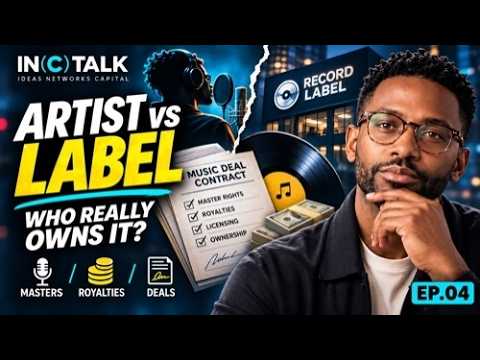
Our EP04 companion goes deeper into the rights, recoupment, partnerships, ownership and AI rules changing the music business. It is designed to be read alongside the episode, not passed off as its transcript.
Explore the IN(C) TALK channel for our latest episodes and related music-business investigations.
1. Owning a master is not the same as owning the song
Copyright recognizes a musical work (the composition and any lyrics) and a separate sound recording (the specific captured performance, commonly called the master). The U.S. Copyright Office explains that the works may have different owners and different licenses. Source: U.S. Copyright Office.
Songwriters, publishers, administrators
Artist, label, or another rights holder
An artist may own both rights, just one, or have time-limited control under a license. A songwriter may retain copyright while assigning administration to a publisher. Ask “Which part?” whenever someone says they own the music. Ownership, control and collection are related, but not interchangeable.
2. The music industry is growing. That doesn't establish your payout.
The IFPI Global Music Report 2026 reports US$31.7 billion in worldwide recorded-music revenue for 2025, up 6.4%, with total streaming representing 69.6% of that market. The RIAA's 2025 U.S. report reports approximately US$11.5 billion in U.S. wholesale recorded-music revenue. These represent different geographic totals, and the U.S. is inside the global figure. Do not add them together.
Both are market measures, not songwriter income, an individual artist's net receipts or a streaming rate. On-demand streaming payouts depend on licensing arrangements, markets, subscription mixes, rights and contract terms. The idea of a universal “dollars per stream to the artist” rate is misleading.
Music-industry headlines can also obscure distinctions between gross receipts, royalties credited, advances paid, recoupable costs and actual cash distributions. Those are different numbers.
3. Where do music royalties go?
Follow the recording and composition sides separately. Recording revenue can pass from a digital service to a master rights holder, label or distributor, then to an artist under a specific agreement. Composition royalties follow different publishing and collective-licensing channels.
In the U.S., The Mechanical Licensing Collective (MLC) handles covered digital mechanical royalties for musical compositions under the statutory blanket license. It does not collect every type of music royalty. SoundExchange administers statutory digital performance royalties for sound recordings on qualifying noninteractive services, such as certain forms of internet and satellite radio. That is not the same payment channel as on-demand master royalties from interactive streams.
Practical rights audit
For each release, record the composition writers and splits, master owner/controller, publishing administrator, distributor, identifiers and registrations, royalty statement source, recoupment balance and contract term. Missing or disputed information should be reviewed before financial assumptions are made.
4. Record advances and recoupment: why the check isn't the whole story
An advance is money an artist receives upfront. When it is recoupable, the contract may apply future royalty credits to clear that balance before paying additional artist royalties. The details vary substantially from deal to deal.
Fictional teaching example: An artist receives a $12,000 advance. Later royalty statements credit $3,000, then $4,000, then $8,000. The first two statements reduce the recoupable balance to $5,000. The last $8,000 clears that $5,000 and leaves $3,000 of additional royalty cash, assuming there are no other deductions.
Across the modeled periods, the artist has received $15,000 in total cash ($12,000 upfront + $3,000 later), matching the $15,000 in royalties credited. This is not a profit calculation; operating costs, taxes, contract deductions and time value are excluded. The advance was received earlier, not automatically “taken away” by recoupment.
5. Independent vs. label vs. partnership: three different trades
Use the same hypothetical starting point, $100,000 in master-side royalty earnings, to see why two artists' bank balances may tell different stories. These are fictional simplified arrangements and not typical deal terms, industry averages, or comparable profit margins.
| Model | Illustrative cash result | Ownership & trade-off |
|---|---|---|
| Artist One: self-distributes | $100,000 − $12,000 distribution − $25,000 artist-funded expenses = $63,000 before tax | Artist retains the master but pays costs and shoulders execution risk. |
| Artist Two: label agreement | 20% royalty credit = $20,000; $12,000 prior advance recouped; $8,000 new cash. $20,000 total cash across periods including the prior advance. | In this fictional contract the label owns the master; label-funded expenses and services have not been assigned a value here. |
| Artist Three: partnership | 20% partner fee leaves $80,000; 70% artist share = $56,000; less $5,000 recoupment and $12,000 expenses = $39,000 before tax | Master ownership depends on the partnership language; costs and functions differ. |
All figures are constructed examples. The cash-flow figures use different cost allocations and periods, making them unsuitable for ranking deal profitability. No inference about real label payouts or standard industry royalty rates is intended.
For another perspective, read our interactive record-deal economics article, which examines recoupment and alternative assumptions.
6. Artists build businesses beyond streaming
Recorded music may be the foundation, but an artist business can include concerts, merchandise, brand partnerships, licensing for film and advertising, fan memberships and direct-to-consumer products. These revenues carry their own costs, ownership issues and operational obligations.
So-called 360 deals may give a partner contractual participation in some categories beyond recordings, but neither the percentage nor the partner's duties are universal. Compare the capital, distribution, tour support, marketing services, term, approval rights and exit obligations against the revenue surrendered. Gross sales are not net profit, and “independent” does not necessarily mean operating without partners.
When music becomes an asset
A music catalog can include recording copyrights, composition interests, licenses and royalty entitlements. Value depends not only on audience demand but on what rights can actually be assigned, licensed, collected or recovered at the end of a term. The rights inventory is part of the business model.
7. AI music, copyright and licensing in 2026
AI tools can support creation, production, discovery and marketing, but rights questions vary by use: training on existing works, copying or adapting recordings, voice likeness and digital replicas, output ownership, licensing income, consent and disclosure are not a single legal issue.
The U.S. Copyright Office's AI initiative has published reports on digital replicas and copyrightability, plus a pre-publication analysis of AI training. Its guidance on copyrightability distinguishes works with sufficient human-authored expression from outputs generated without it. The application of laws to particular training practices and disputes remains fact- and jurisdiction-dependent.
Separately, the Copyright Office announced a music streaming-fraud inquiry on October 7, 2026. An inquiry seeks evidence and views; it is not a final legal determination about AI, a specific company, or an artist.
The contract questions remain practical: who may use a recording, composition or voice in AI systems; whether sublicensing is permitted; what consent is required; how revenue is measured; whether rights survive termination; and how usage can be audited.
8. Five questions to ask before a music deal
- Who owns or controls the master, for how long, and are there reversion rights?
- Who owns or administers the composition, and are writer splits and registrations correct?
- Which revenue streams are covered, including merchandise, touring, sync and AI licensing?
- What recoups, against which royalties, with what cross-collateralization, accounting and audit rights?
- What happens when the deal ends, including distribution control, exclusivity, data access and termination obligations?
These questions organize the diligence. They are not individualized legal advice or a substitute for reviewing the actual agreement with a qualified entertainment attorney and financial adviser.
Frequently asked questions
Who owns a song's master recording?
The master recording is a separate copyright from the underlying musical composition. Its owner or controller depends on who created it, any applicable agreements, transfers, and licenses. Do not infer ownership from the artist's name on the release.
Does one million music streams guarantee a fixed payout?
No. There is no universal per-stream payment to an artist. Money travels through service terms, recording and publishing rights, distributors, contracts and administration; the artist's final cash depends on those terms.
What is recoupment in a record deal?
Recoupment is the contractual application of eligible future royalty credits to recover an advance or specified costs. An advance is already cash received; a zero new royalty check does not mean the artist received no money.
What is the difference between music masters and publishing?
The master concerns the particular recorded performance; publishing concerns the underlying composition and lyrics. A single song can generate multiple streams of income owed to different owners.
Can an AI-generated song be copyrighted?
In U.S. Copyright Office guidance, eligibility depends on sufficient human-authored expressive elements; prompting alone is not necessarily enough. Questions about AI training, voice replicas and licensing are legally distinct and may remain contested.
Sources and research notes
Primary-source materials support the descriptions of copyright categories, royalty systems, dated revenue figures and reported policy developments. The artist cash-flow models are original fictional exercises; they are not attributed to those sources. Figures describe 2025 where stated, although the report was published in 2026.
- IFPI, Global Music Report 2026 (March 18, 2026)
- RIAA, 2025 Year-End Recorded Music Revenue Report (March 2026)
- U.S. Copyright Office, What Musicians Should Know about Copyright
- The Mechanical Licensing Collective, Music Industry Terminology
- SoundExchange, Licensing 101
- U.S. Copyright Office, Copyright and Artificial Intelligence
- U.S. Copyright Office, October 2026 Music Streaming Fraud Notice of Inquiry
Last editorial source review: October 31, 2026. Legal developments and market reports may change. Read our research methodology and source standards.
Keep following the money
Watch IN(C) TALK on YouTube and join the discussion: what matters most to you when evaluating a music career, upfront funding or lasting ownership?
Editorial disclosure: This is a general educational explainer. Fictional examples do not establish typical payout rates, profits, contract offers or individual rights. No legal, tax, investment or financial advice is provided.